
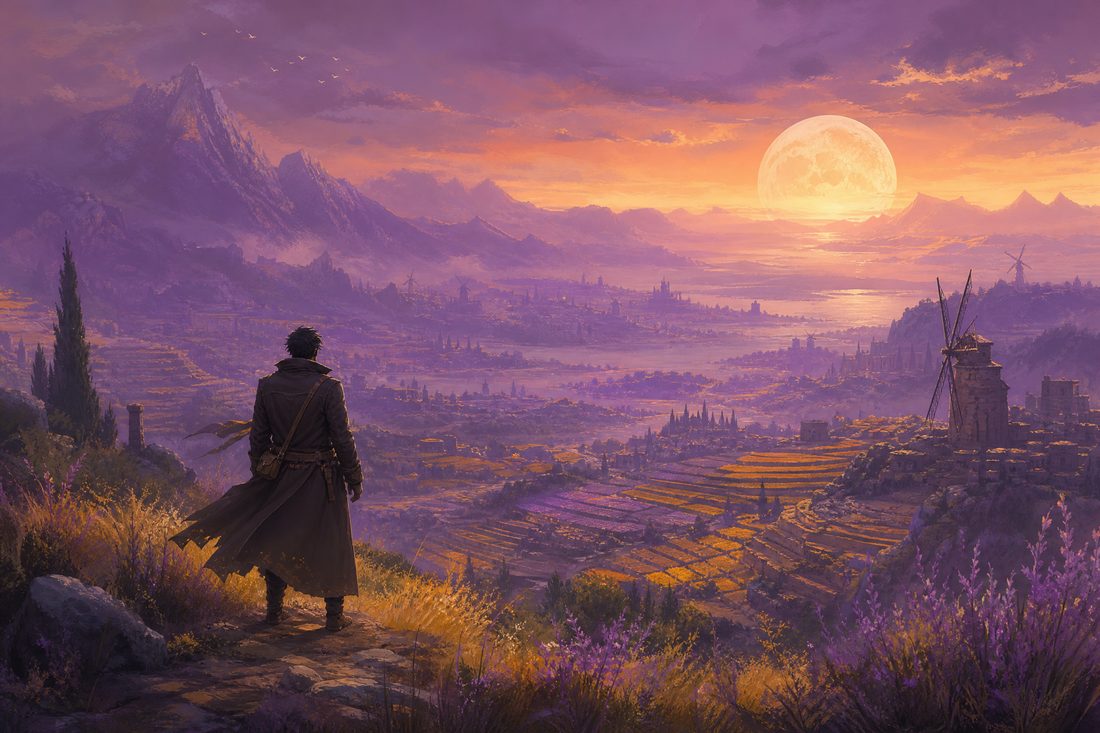
The temptation with a game like this is to write about the valley. It deserves it: the terraces are legible from a distance, the windmills are placed where you would place them if you had to grind grain rather than compose a screenshot, and the moon does an enormous amount of work orienting you at night without a compass.
But the thing that makes it play well is that you can leave and return in four seconds. Everything else follows from that.
What four seconds buys
Fast travel in an open world is usually a compromise: the game gives you the shortcut and then charges you a loading screen for using it, so you end up walking to avoid the wait, which is not what the walking was for. Here the charge is small enough to disappear, and the behaviour it produces is different in kind rather than degree.
We noticed it around hour nine. We had stopped planning routes. If a thing looked interesting on the far ridge we went to look at it, and if it turned out to be nothing we came straight back, and neither decision cost anything worth weighing. That is the state open worlds are supposed to produce and rarely do.
| Measurement | Tidewalker | File median |
|---|---|---|
| Cold boot to first input | 11s | 34s |
| Warm boot | 7s | 19s |
| Fast travel, worst case | 4s | 16s |
| Respawn after death | 1.8s | 8.4s |
| Visible area transitions | 0 | Present in 31 of 41 |
The death loop
Under two seconds, measured across a hundred and forty falls, most of them ours and avoidable. The screen does not fade to black and back; it dims, the camera resets to the last solid ground, and you are moving again before you have finished being annoyed.
The consequence is that we climbed things we had no business climbing. Failure was cheap, so experimentation was cheap, and a substantial part of what we enjoyed about this game happened in places the designers presumably did not intend us to reach on the fourth attempt.
A cheap death is a design decision about curiosity. Every second you add to the respawn is a second of argument against trying the harder route.
Where it slows
Two places. The first launch after an update recompiles shaders and takes between fifty and seventy seconds, with a progress figure, which is the correct way to do an unavoidable thing. We record it and we do not hold it against the game.
The second is the map screen, which takes a beat longer than it should to become interactive — about half a second of unresponsiveness after it appears, during which clicks are silently discarded. It is small, it is the only place in the game where an input vanished, and it stands out precisely because nothing else here does.
The game underneath
Worth saying plainly, since this site can give the impression that speed is all we care about: the exploration design here is very good independently of the timings. The valley is built around sightlines rather than markers, the settlements have economic logic that survives inspection, and the traversal upgrades change how you read terrain rather than merely opening gates.
It is not perfect. The late-game quest structure sags into fetch work for about four hours, the combat is functional rather than interesting, and there is a stretch around the northern marsh where the density drops off badly. An 8.6 rather than a 9.
| Element | Assessment |
|---|---|
| Fast travel | Best result recorded in the file |
| Death and respawn | Cheap enough to encourage risk |
| Shader compilation | Long but honest, with a figure |
| Map screen | Half a second of discarded input |
| Late-game structure | Four hours of fetch work |
Where this leaves it
The fastest large world we have timed, and the review is a recommendation rather than a technical note. What is worth taking from it is the causal direction: the speed did not merely make the game more pleasant, it changed what we were willing to do inside it, and no difficulty slider or quest marker would have produced the same effect.