
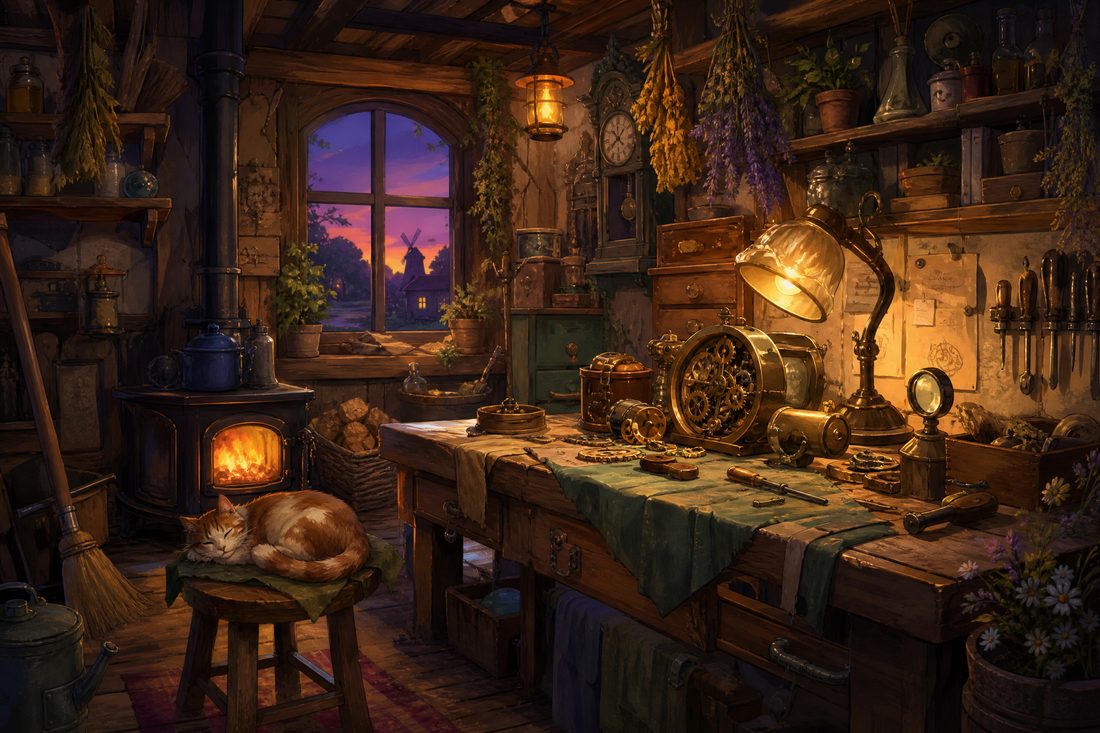
The pleasure of this game is continuity. You are mending clockwork for a village that brings you broken things, and the loop is: take the object, open it, work out which of four subsystems has failed, fix it, and hand it back. You do this several hundred times and it does not get old, because each object is a small legible puzzle rather than a recipe lookup.
What makes it feel different from every comparable game we have timed is that the world never stops moving around you.
Six seconds, once
Cold boot from double-click to controllable: six seconds, consistent across three runs with a cleared cache. Warm boot: four. After that there is nothing. Walking out of the workshop into the village does not load. Entering another building does not load. Sleeping to the next morning does not load.
We waited for the catch, since a seamless world usually pays for itself with a stutter at the boundary or a pop-in of detail as you cross it. We watched for it deliberately for about two hours and did not find one.
| Measurement | Menders Yard | File median |
|---|---|---|
| Cold boot to first input | 6s | 34s |
| Warm boot | 4s | 19s |
| In-game loading screens | 0 | Present in 38 of 41 |
| Visible autosave stalls | 0 | Present in 22 of 41 |
| Menu-to-play after launch | 1s | 7s |
The invisible autosave
This is the part worth stealing. Most games in this file save on a timer and produce a brief hitch when they do, and several of them save on room transitions, which is why the transitions are slower than the loading they perform.
Here the save is incremental and continuous, and we could not detect it. We looked: we watched the frame counter for an hour, we tried to provoke it by doing something expensive while the timer would have been due, and we found nothing. In a game whose whole texture is uninterrupted work, that is not a technical footnote either.
The most respectful thing a game can do with your time is take none of it without telling you, and then not need to tell you very often.
Scope as a strategy
An honest caveat: this is a small game. One village, one workshop, a cast of eleven, and a world you could cross on foot in about ninety seconds. It is much easier to keep everything resident in memory when there is less of everything.
But that is a choice, not an excuse, and the choice paid for itself. A great deal of what makes this game pleasant is a consequence of its scale, and the absence of loading is one item on that list rather than a lucky side effect.
What it costs elsewhere
There is not much game here in raw hours if you are not enjoying the loop. The main thread resolves in about eighteen hours; our forty-four were mostly voluntary. The late repairs repeat mechanisms you have already learned, and the village dialogue starts recycling around hour thirty.
It also has one genuine failing: no way to rebind the mouse buttons, which given how much of the game is precise clicking inside a mechanism is a real omission rather than a nitpick. Everything else in its options is complete.
| Element | Assessment |
|---|---|
| Cold boot | Fastest in the file |
| In-game loading | None at all |
| Autosave behaviour | Undetectable; the model to copy |
| Scale | Small, deliberately |
| Mouse rebinding | Absent; a genuine failing |
Where this leaves it
The highest score on this site so far, and the review is about the game rather than the stopwatch. What the timings add is evidence for something the play already suggests: continuity is a feature you can feel without being able to name, and this is the clearest demonstration of it we have recorded.