
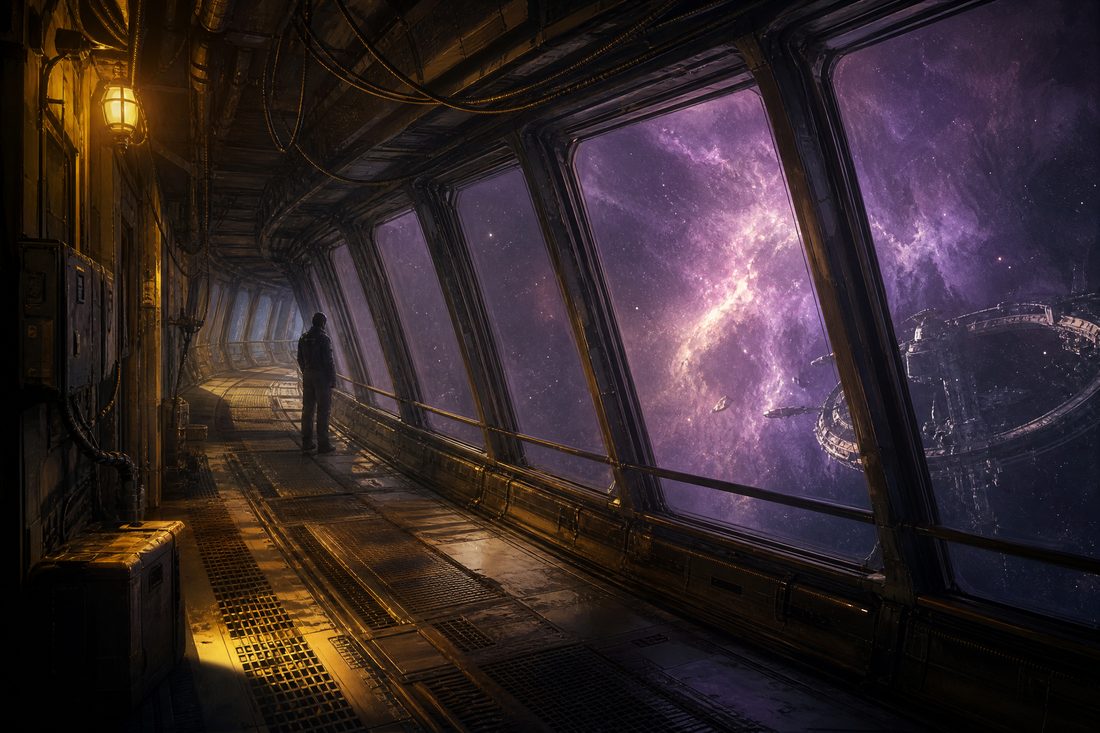
You are the clerk on a mid-sized orbital station: you route cargo, arbitrate small disputes, keep four departments supplied and occasionally deal with something going wrong in a way the manual did not anticipate. It is a good simulation with an unusually strong sense of place, and the station is laid out over six decks connected by one central lift.
The lift is where the game loads. It is also where the game is at its most confident, which is what makes this difficult to write.
The trick, and its cost
The first dozen rides are excellent. The doors close, the numbers climb, the ambient noise of the deck you are leaving fades out and the one you are arriving at fades in, and twice in that first hour a crew member got in with you and said something that mattered. It is craft, it is exactly what people mean when they praise diegetic loading, and it does not survive repetition.
By hour ten the lift is a corridor with a timer. By hour thirty we were tabbing out during it, which is the behaviour a loading screen produces and the entire technique exists to prevent.
| Measurement | Orbit Clerk | File median |
|---|---|---|
| Cold boot to first input | 28s | 34s |
| Warm boot | 16s | 19s |
| Deck change, total | 11s | 16s |
| Deck change, actual load | 4s | Not comparable |
| Skippable portion | 0s | Varies |
Counting the rides
We kept a tally, because the aggregate is the only honest way to assess a small repeated cost. Three hundred and forty deck changes across one full campaign of fifty-two hours, which at eleven seconds each is sixty-two minutes.
An hour of elevator. That is longer than several games we have reviewed take to complete, and it is not distributed evenly: the mid-campaign stretch where four departments need daily attention produced up to twenty-two rides in a single session.
Diegetic loading solves the problem of a wait feeling like a wait. It does not solve the wait, and after the fortieth repetition the two are the same thing again.
Seven of eleven seconds
The measurement that matters: the actual load completes in about four seconds. We established this by watching drive activity, and then confirmed it by noticing that the arrival deck is fully populated well before the doors open.
So seven of the eleven seconds are the animation insisting on its own completeness. A skip after the first two rides to a deck would cost the game nothing that it has not already earned, and would remove fifty minutes from the campaign we played.
The simulation
Which is a shame, because the game around the lift is good. The four departments have genuinely different logics, the supply chain is legible without being trivial, and the small disputes you arbitrate accumulate into a station with a personality by the end. The writing is dry and very well judged.
Its other weakness is unrelated: the cargo manifest screen sorts by arrival time and cannot be sorted any other way, which by the late campaign turns a routine task into a search. The options menu is otherwise thorough, with full rebinding and three text sizes.
Where this leaves it
A recommendation with a stopwatch attached. The lift is the best-made loading transition in the file and it is still a loading transition, which is the argument this review exists to make: hiding a wait inside fiction buys you the first ten repetitions and nothing after that, and the fix is a skip rather than a rebuild.